
Crafting your Book Description
If there’s one part of your book that tends to cause a surprising amount of stress, it’s the book description.
You’ve poured your heart into writing thousands of words, and now you’re asked to sell it in 150–250 words on the back cover and a little box on Amazon. No pressure, right?
If you’re feeling overwhelmed by this part, you’re absolutely not alone. Many authors tell me they’d rather rewrite three chapters than tackle their blurb. But once you understand what a book description is actually meant to do (and what it’s not), it becomes far less intimidating—and a lot more fun.
Let’s walk through it together.
Your book description is not a summary
The first mindset shift is this: your book description is a sales tool, not a summary.
A summary tries to explain what’s in the book.
A sales-focused description invites someone to want what’s in the book.
Those are very different jobs.
If you’re writing fiction, a summary might walk through the whole storyline: who the characters are, what happens in the middle, and how it ends.
A strong blurb, on the other hand, introduces just enough of the main character and central problem to make your reader think, “Ooh, I need to know what happens.”
If you’re writing non-fiction, a summary might list every topic you cover, chapter by chapter.
A strong description doesn’t list everything. It focuses on the main problem your reader has, the outcome they want, and why your book is the right bridge between those two points.
A helpful way to think about it is this:
The goal of your description is not to prove you wrote a thorough book.
The goal is to create enough curiosity, emotional connection, and clarity that the right reader wants to keep reading—and ultimately buy the book.
Once you let go of the idea that your description has to explain everything, the job becomes much lighter. You’re not trying to squeeze your whole book into a paragraph. You’re simply opening the door and inviting the right people in.
Why your opening lines matter so much
Online, readers move quickly.
They might see your cover and title for half a second while scrolling. If that catches their eye, they’ll usually glance at your first line or two of the description before deciding whether to keep going or click away.
Those first few lines are incredibly valuable real estate. Don’t waste them on backstory, praise, or vague statements.
Instead, aim for a clear, compelling hook that speaks directly to what your ideal reader cares about most.
For fiction, that might look like:
- A gripping situation: “On the night her husband disappears, Emma discovers the secret he’s been hiding for years.”
- A bold question: “What if the only person who could save your life was the one you swore never to trust again?”
For non-fiction:
- Directly naming the problem: “You’re exhausted, overwhelmed, and secretly wondering if you’re doing this parenting thing all wrong.”
- Painting the desired outcome: “Imagine walking into your next presentation calm, confident, and knowing exactly what you’ll say.”
Notice what these lines do:
- They’re simple and easy to understand.
- They point to an emotional tension or desire.
- They spark curiosity without explaining everything.
If a reader feels seen, intrigued, or understood in those first sentences, they’re far more likely to read the rest of your description.
Keep it clear, readable, and focused
Once you’ve hooked the reader, your job is to keep them with you. This is where clarity and readability really matter.
A few practical things to keep in mind:
- Keep the language simple.
- Avoid name overload in fiction: Readers don’t need to meet every character in the book. Too many names in a short space creates confusion and distance.
- Think about how it looks on the page: Use small paragraphs
- For non-fiction, talk about the reader more than the content.
Instead of:
“This book covers mindset, productivity, habits, and time management.”
Try:
“You’ll learn how to reclaim your time, follow through on your priorities, and finally stop feeling guilty about your to-do list.”
Same information, but framed in terms of what they get out of it.
Write for your ideal reader (not for everyone)
You cannot—and should not—try to attract everyone with your description.
Your job is to speak directly to the person who is most likely to love your book.
Ask yourself:
- Who is this book really for?
- What are they feeling before they find it?
- What are they hoping will change after reading it?
If you’re writing a cozy mystery, your tone should reflect warmth, charm, and gentle intrigue—not brutal violence or high-stakes thriller language.
If your book is for busy mums, say that. If it’s for small business owners, say that. Let people recognise themselves in your words.
This clarity not only helps the right reader say “Yes, this is for me,” it also gently helps the wrong reader step away. That’s a good thing. You want enthusiasm from the right readers, not lukewarm interest from everyone.
A simple structure you can follow
To pull this all together, here’s a straightforward structure you can use as a starting point for your description. You can adjust it for fiction or non-fiction, but the bones remain similar:
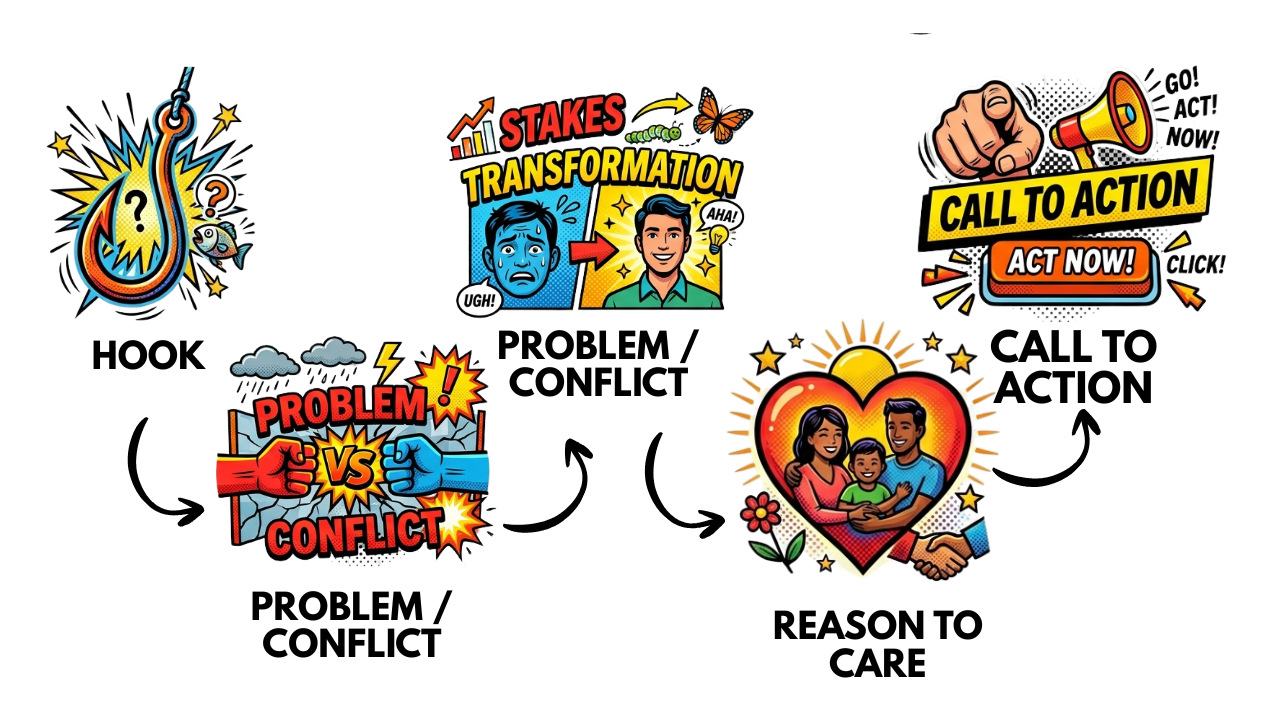
- Hook – A strong first sentence or two that taps into curiosity or emotion.
- Set-up – For fiction, briefly introduce the main character and central problem. For non-fiction, name the reader’s problem or desire.
- Escalation – Hint at what’s at stake if nothing changes or how things become more complicated.
- Promise – Suggest the journey or transformation your book offers, without giving everything away.
- Call to action – A simple line inviting the reader to start reading: “If you love… you’ll enjoy…” “Start your journey today…” “Perfect for readers who…”
You don’t have to follow this rigidly, but it gives you a clear path so you’re not staring at a blank screen wondering where to begin.
You don’t have to get it perfect on the first try
Like every other part of publishing, writing a strong book description is a skill you can learn and improve.
Give yourself permission to write a messy first draft. Read it aloud. Ask yourself, “Does this make me want to read the book?” If the answer is “not yet,” that’s okay—you now know what to tweak.
Remember: your description isn’t about proving how much you’ve written. It’s about offering a clear, inviting doorway to the wonderful work you’ve already done.
If you’d like to see this broken down step-by-step—with examples, common mistakes to avoid, and a walk-through you can follow as you write—feel free to watch the video that goes with this post or join us inside the membership, where we go through this together and you can get feedback on your own blurb.
For all the details, grab your free trial now. You’ll get ongoing support, live Q&A calls, access to our videos anytime, and step-by-step guidance through the entire publishing process.
www.publishwithpurpose.com.au
Kathy Shanks

Turtle Publishing was founded in 2020 by self-employed designer and happily married mother of two, Kathy Shanks. With 20 years of design experience and having created her own journal in 2019, where she subsequently believes that the ‘universe started throwing books at her’, Kathy is passionate about creating designs that convey the right emotion and ‘vibe’ to the right audience and specialises in budget friendly publishing solutions.

Add Comment